Your employer brand is not what your career pages publish. It is the sum of every experience a candidate has with your organization, at every touchpoint. For hiring teams, it begins from the first moment they see your job posting to the moment they receive, or never receive, a final decision.
CHROs and talent leaders at scaling companies invest significantly in employer brand architecture: EVP frameworks, career site design, culture documentation, and employee advocacy programs. These are necessary investments. But they address perception at the top of the funnel while leaving the candidate experience downstream largely unmanaged.
The gap between what your brand promises and what candidates actually encounter inside your hiring process is where reputations are built and quietly dismantled, often without a single executive being aware it is happening.
The Platforms Where Employer Brand Reputation Forms First
Understanding where candidates discuss your hiring process is the first step toward protecting the brand equity you have worked to build. These are not peripheral channels. They are the infrastructure through which talent market perception solidifies.
Glassdoor and Indeed
Interview experience ratings are publicly indexed and appear in Google search results for your company name. A sustained pattern of negative screening feedback compounds over time, influencing passive candidate decisions before your recruiter ever sends an outreach message. Candidates actively filter companies by these signals before applying.
A candidate who had a poor interview experience has an immediate audience of hundreds of first-degree connections and a potential extended reach of tens of thousands. A single post, shared by two or three professionals in your target talent segment, can define your hiring reputation in that community within 48 hours.
Reddit and X (formerly Twitter)
Communities such as r/cscareerquestions document hiring pipelines in granular detail. Technical hiring processes at specific companies are compared, rated, and archived. Posts warning candidates away from applying persist in search results for years and are actively consulted by the candidates you most want to attract.
Professional Referral Networks
Word of mouth operates invisibly and is arguably the most consequential channel of all. When a candidate tells three colleagues that your process was disorganized or disrespectful, those colleagues self-select out of your talent pool before you are ever aware of the loss. No analytics dashboard captures this, which is precisely why it compounds undetected.
The Real Driver of Employer Brand Damage at Scale
Organizations often assume that employer brand damage spikes when something dramatically wrong occurs: a recruiter behaves poorly, a role is misrepresented, or a candidate is treated without basic professional courtesy. Those incidents matter, and they must be addressed.
But the data on candidate experience consistently points to a quieter and more systemic cause: silence.
Candidates understand rejection. What they do not accept, and what they increasingly publish their experiences of in 2025 and beyond, is being treated as though they never applied at all. The candidate ghosting problem is not a recruiter character issue. It is a structural failure that scales in direct proportion to hiring volume.
When a recruiting team is managing 40 to 60 open roles simultaneously, candidate communication does not scale by default. Applicants who invested time tailoring applications, preparing for screening calls, and completing technical assessments receive nothing in return. That absence of response is experienced as a deliberate signal. It damages both the individual relationship and the aggregate reputation.
Ghost Hiring and Its Cost to Talent Brand Equity
One of the most documented patterns damaging employer brands heading into 2026 is what candidates call ghost hiring: roles that are posted publicly, marked as actively reviewing on LinkedIn, and then go silent with no update, no rejection, and no explanation.
The role may have been budget-frozen. It may have been filled internally. The hiring manager may simply be moving slowly. The candidate knows none of this. What they know is that they invested two to three hours preparing a targeted application and received nothing in return. That experience becomes a Glassdoor review. That review becomes a pattern. That pattern becomes a permanent fixture of how your organization is perceived in the talent market.
The multi-stage interview process that loses momentum is equally corrosive. A candidate who advances through a screening call, a technical assessment, and a hiring manager interview, then hears nothing for three weeks, is not simply disappointed. The professional relationship is damaged. Whatever your employer brand represented when they applied is now filtered through the lens of feeling disrespected.
For organizations competing for talent in high-density markets where professional networks are dense and LinkedIn reach compounds quickly, this damage propagates faster and farther than most leadership teams appreciate.
Why Conventional Employer Branding Strategies Fall Short
The traditional approach to employer branding treats it as a marketing and communications problem. The solution, therefore, becomes more content, stronger storytelling, more consistent LinkedIn presence, and better culture documentation. None of these are wrong. But they address perception at the top of the funnel while leaving the candidate experience downstream entirely unaddressed.
The moment of brand formation for most candidates is not when they engage with your thought leadership content. It is when they submit an application and wait. It is when they complete a final interview and wonder if any follow-up will come. It is when a rejection arrives as a single automated line that acknowledges nothing about what they contributed during the process.
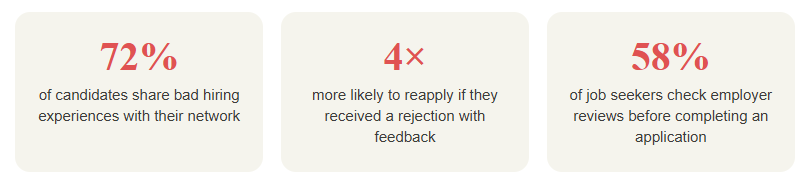
Employer brand reputation is built and lost in the operational gaps, in the hours and days between candidate touchpoints. Most organizations leave those moments empty by default, and candidates fill that silence with their own interpretations.
What Structurally Sound Hiring Pipelines Actually Look Like
Organizations with consistently strong employer brand reputations in competitive talent markets have not simply invested more in communications. They have built operational infrastructure that delivers consistent, respectful, and efficient candidate experiences at scale. Three characteristics differentiate how these organizations structure their hiring pipelines.
Structured Screening That Standardizes the Candidate Experience
When every candidate at the same stage receives
- The same quality of engagement
- The same evaluation framework,
- the same depth of assessment,
the hiring process itself becomes a brand asset. Structured AI-led screening, using Structured Playbooks and competency-based questioning frameworks, ensures that evaluation criteria are consistent and no candidate encounters a materially worse experience due to recruiter availability or fatigue. Consistency at this level is what operationalizes the principle of Human-first hiring at scale.
Communication Cadences That Treat Candidate Time as an Asset
Candidates should understand what to expect at every stage, including realistic timelines and a named next step. A status update after a week of silence is not logistically difficult to deliver. It is an operational choice. Organizations that build automated communication cadences into their hiring infrastructure, with clear progression signals and structured feedback loops at every stage, convert a functional necessity into a meaningful brand signal. Candidates remember being kept informed, even when the answer is not yet available.
Meaningful Closure at Every Stage, Not Template Dismissal
A rejection that acknowledges a candidate’s investment and provides even a general indication of where the evaluation landed is dramatically better received than a generic automated message. It signals that a human was engaged in the decision. It signals that the organization respects the time candidates contributed. Over years and thousands of candidates, this builds a reputation for treating applicants with dignity regardless of outcome, which is itself a talent acquisition strategy.
Employer Brand Infrastructure as a Strategic Priority for CHROs
The operational challenge is real. Screening processes designed for twenty applicants per role are visibly inadequate at two hundred. As hiring volume scales, candidate communication typically does not scale with it unless the infrastructure is deliberately built to do so.
This is where the most consequential shift in thinking is required. Candidate experience is not a recruiter responsibility. It is an organizational capability that demands investment at the same level as any other operational function that carries reputational and financial risk.
For CHROs evaluating where employer brand vulnerability is highest, the answer is almost never in the content strategy. It is in the volume hiring pipeline, in the screening infrastructure, and in the follow-up systems that either sustain or break candidate trust between touchpoints.
AI-powered Interview as a Service platforms, such as JobTwine, address this directly. By delivering structured screening through a Digital Avatar model with always-on availability, organizations give every candidate a consistent, high-quality experience regardless of hiring volume. Recruiters are freed from the operational burden of scheduling and screening coordination, allowing them to direct human attention where it creates the highest value: in the high-stakes conversations that determine whether your best candidates choose you.
Early attrition data reinforces the business case. Organizations that implement structured, competency-based screening see 20 to 30 percent reductions in early attrition, because the quality of match improves when evaluation is rigorous and consistent. The employer brand benefit and the retention benefit are the same investment.
The Bottom Line: Employer Brand Equity Is Built in the Operational Gaps
The organizations with the strongest employer brand reputations in competitive talent markets are not the ones with the largest content budgets or the most polished career pages. They are the ones that have built operational systems ensuring every candidate, regardless of outcome, is treated as someone whose time and professional investment matter.
The gap between those organizations and the majority is not brand ambition or budget. It is process architecture.
Employer brand equity is built in the moments that marketing cannot reach: in the screening experience, in the communication between interview stages, in the rejection message that either leaves a candidate feeling respected or turns them into a vocal critic in a talent network your next great hire is part of.
Building that infrastructure is the most durable investment a CHRO can make in the long-term strength of their employer brand and the long-term quality of the talent that chooses to join their organization.
Ready to see what structured candidate experience looks like at scale?
Book a JobTwine demo and see how Interview as a Service transforms your hiring pipeline into an employer brand asset.
Book A Demo