Every recruiter knows the feeling. It’s Monday morning. You have dozens of open roles, a calendar full of screening calls, and hundreds of new applications waiting. This is not just a workflow problem. It is a structural one. No amount of calendar optimization or screening templates will fix it.
AI avatars in hiring are changing that equation. Not by replacing human judgment, but by removing the administrative bottleneck that has been slowing recruiting teams down for years.
But before deploying any AI hiring solution, organizations need to ask a more strategic question: what does a truly intelligent, AI-led hiring flow actually look like, and what does it take to build one?
This article breaks down the real pros and cons of reducing hiring overheads with AI avatars and what strategic HR leaders are doing to stay ahead.
What Are AI Avatars in Hiring, and Why Are They Gaining Traction?
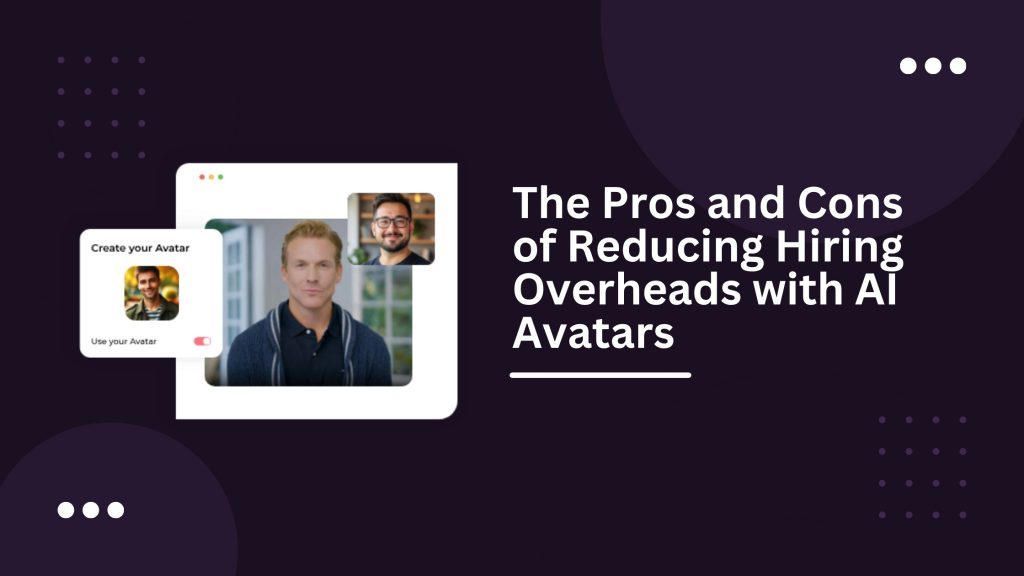
AI hiring avatars are digital interviewers powered by generative AI that conduct structured video screening interviews, respond to candidate questions, and deliver consistent, bias-reduced experiences at scale. Unlike static chatbots or one-way video tools, modern AI avatars interact dynamically and adapt to candidate responses in real time.
The rise of AI avatars is not accidental. Recruitment teams are being asked to do more with less. Talent acquisition budgets are under pressure, hiring volumes are increasing, and candidate expectations for fast and respectful communication are higher than ever. AI avatars sit at the intersection of these pressures.
Organizations using AI-led async screening are reporting major improvements in time-to-shortlist, recruiter productivity, and candidate experience. For talent leaders, the question is no longer whether to use AI in hiring. The question is how to use it strategically.
The Pros: Where AI Avatars Move the Needle
1. Speed at Scale Without Sacrificing Quality
Traditional screening is linear. One recruiter can only conduct a limited number of calls per day. AI avatars remove this constraint completely. A single AI avatar can conduct hundreds of structured screening interviews simultaneously, across time zones, 24/7.
For high-volume roles across tech, retail, healthcare, and staffing, this changes the entire hiring timeline. Recruiters who previously spent most of their week on screening calls can now focus on high-value activities like interviewing finalists, building talent pipelines, and partnering with hiring managers.
This is not just automation. This is capacity creation.
2. Measurable Reduction in Hiring Overheads
Hiring overheads are not just recruiter salaries. They include the cost of delayed hiring, lost productivity, contractor expenses, and recruiter burnout. When roles stay open longer, the business pays for it in multiple ways.
AI avatars reduce hiring overheads by:
- Eliminating scheduling for early-stage screening
- Reducing time-to-shortlist from weeks to days
- Lowering cost-per-screen compared to agencies or RPO
- Reducing recruiter burnout and improving retention
The financial impact is clear. Organizations replacing first-round phone screens with AI avatar interviews are seeing lower cost-per-hire and faster hiring cycles.
3. Structural Consistency and Bias Reduction
Human screening is naturally inconsistent. Energy levels drop, biases appear, and interview quality varies across the day. AI avatars ask the same questions in the same way every time, creating structured and consistent interviews for every candidate.
This improves fairness and supports DEI goals. When every candidate goes through the same structured interview process, evaluation becomes more objective and evidence-based rather than dependent on interviewer mood or bias.
Consistency at scale is one of the biggest advantages of AI-led hiring.
4. Candidate Experience That Converts
Many hiring leaders assume candidates prefer human phone screens. Surprisingly, many candidates prefer AI avatar screening for early-stage interviews. Why?
- They can complete interviews on their own schedule
- No scheduling coordination
- Clear expectations
- Less early-stage pressure
- Faster process
Completion rates for AI avatar interviews are often higher than traditional phone screens and video interviews. A frictionless candidate experience is not just good ethics. It is a competitive advantage in a talent market where speed and communication matter.
5. Liberation of Recruiter Capacity for Strategic Work
This is the most important benefit and the most overlooked.
The purpose of AI avatars is not to replace recruiters. It is to give recruiters their time back. When AI handles first-round screening, recruiters can focus on:
- Candidate relationships
- Final interviews
- Hiring manager alignment
- Employer branding
- Talent pipeline building
- Workforce planning
Organizations that understand this are not just reducing hiring costs. They are upgrading the role of the recruiter from coordinator to strategic talent partner.
The Cons: What HR Leaders Need to Evaluate Honestly
Implementation and Change Management
AI avatars are not plug-and-play. Successful implementation requires role-specific interview design, structured scoring rubrics, and integration with existing ATS and hiring workflows.
Organizations that rush implementation without proper setup often see poor results. The issue is rarely the technology. The issue is implementation quality and change management.
Recruiters may also feel threatened by AI initially. Leadership needs to position AI correctly: AI handles volume. Humans handle judgment. Both are necessary.
The Candidate Acceptance Gap for Certain Roles
AI avatar screening is not ideal for every role. For executive hiring, senior leadership roles, and highly specialized positions, candidates often expect human interaction from the beginning.
The most effective organizations use AI avatars selectively:
- High-volume roles
- Entry-level roles
- Mid-level roles
- Early-stage screening
But they keep human interaction early for executive and niche hiring.
AI should be applied where it adds value, not everywhere.
Over-Reliance Risk: AI Surfaces, Humans Decide
AI avatars are excellent at structured screening, data capture, and scoring against defined criteria. But they should not make final hiring decisions.
The best hiring models use a human-in-the-loop approach:
- AI conducts structured screening
- AI generates candidate reports and scores
- Humans review and make final decisions
AI should support decision-making, not replace it.
This Is the Moment to Redesign AI-Led Hiring Flows
The companies that will win in hiring are not the ones adding AI to old workflows. They are the ones redesigning hiring workflows around AI capabilities.
Most recruiting processes today were designed for a pre-AI world:
- Manual screening calls
- Manual scoring
- Resume-based shortlisting
- Scheduling coordination
- Disconnected interview stages
AI avatars allow organizations to redesign hiring workflows completely.
A modern AI-led hiring flow looks like this:
- AI avatar conducts first-stage structured interviews
- AI generates scored candidate reports
- Recruiters review shortlisted candidates
- Humans conduct final interviews
- Hiring managers make decisions using structured data
- Candidate data feeds into talent pool for future roles
This is not a future concept. Leading talent acquisition teams are already building this model.
Moving Toward Strategic Hiring: What the Best Teams Are Doing Differently
High-performing recruiting teams in 2026 treat AI as infrastructure, not a tool.
Here is what they do differently:
They Measure Quality of Hire, Not Just Time to Hire
They track how early-stage AI screening scores correlate with 90-day performance and retention. Over time, this improves hiring accuracy and quality-of-hire.
They Treat Candidate Experience as a Brand Asset
Every interaction is an employer brand moment. A structured, transparent, and fast AI interview process signals professionalism and respect for candidate time.
They Use AI to Empower Recruiters, Not Replace Them
The best companies do not reduce recruiters. They increase recruiter productivity and hiring output by removing administrative work.
They Establish AI Governance Early
They define:
- What AI evaluates
- What humans decide
- How candidates are informed
- How bias is monitored
- How hiring decisions are audited
This reduces risk and builds trust in AI-led hiring.
The Human-First AI Advantage
Reducing hiring overheads with AI avatars is not just a cost reduction strategy. It is a capability strategy.
Organizations using AI avatars correctly are building recruiting functions that are:
- Faster
- More consistent
- More data-driven
- More candidate-friendly
- More scalable
AI does not replace human judgment. It protects human judgment by removing administrative overload and giving recruiters the time and data they need to make better decisions.
The shift toward AI-led hiring is already happening. The only question is whether organizations will design this shift intentionally or fall behind competitors who move faster.
Closing: Why JobTwine AI Avatars Stand Out
Not all AI avatars are the same. The difference between a basic AI interview tool and a truly intelligent AI interviewer comes down to how naturally it can conduct interviews and how intelligently it can evaluate candidates.
This is where JobTwine’s AI avatars stand out.
JobTwine AI avatars are dynamic and feel natural, creating interview experiences that feel like real conversations rather than scripted questionnaires. They conduct real-time probing based on candidate responses, which means interviews go deeper instead of staying surface-level. The avatars can lead the conversation end-to-end without human intervention, ensuring every candidate gets a consistent and structured interview experience.
One of the most powerful capabilities is that organizations can clone their best recruiter’s interview style into an AI avatar. This means your best recruiter can effectively interview thousands of candidates at scale. The AI avatar not only conducts the interview but also assesses the candidate and generates a structured report immediately after the interview, giving hiring teams decision-ready insights instead of just recordings.
This is the difference between automation and intelligence. Automation reduces effort. Intelligence improves hiring decisions. JobTwine is built for both.