Your best recruiter is called “the best” for a reason. They ask the right questions. They read the room. They know within five minutes whether a candidate belongs on the shortlist. That skill took years to build.
But there is a structural problem. That capability exists in one person, not in the system.
Every day, your top recruiter is spread across 20 open roles, reviewing hundreds of applications, and still spending prime decision making hours on repetitive 15 minute screening calls. This is not a talent problem. This is an allocation of intelligence problem.
While your best recruiter is on screening calls, hundreds of candidates sit in the queue. Pipelines slow down. Time to hire increases. And the organization unknowingly creates a bottleneck around its most valuable hiring asset.
The question is not whether you have a strong recruiting team.
The question is whether the judgment of the best ones can be scaled across every interview, every role, and every candidate conversation.
The digital recruiter avatar changes this equation completely.
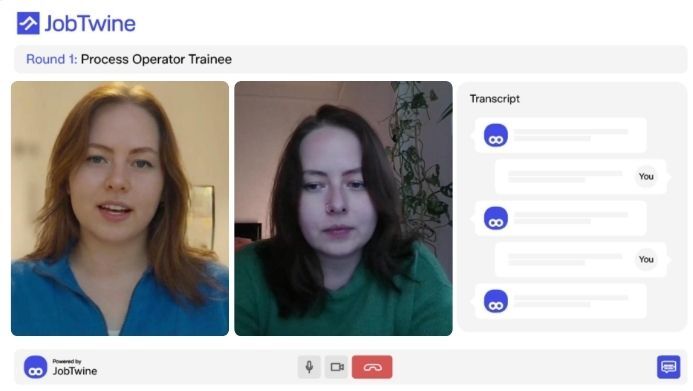
This is not a chatbot. This is not a voice bot reading from a script. This is a video-based, real-time AI interviewer that looks, sounds, and thinks like your top recruiter, running every first-round screen at the quality level you have spent years building.
Here is what that shift actually means for your hiring operation.
1. The Expertise Problem: One Recruiter, Hundreds of Requisitions
Traditional hiring has a single point of failure: the recruiter’s calendar.
Your best recruiter can screen 8 to 10 candidates a day. That is the ceiling. Every insight they carry, every signal they know to probe for, every instinct about candidate fit, stays locked inside one person’s working hours.
A digital avatar breaks that ceiling.
When you encode your top recruiter’s evaluation logic into a structured AI playbook and deploy it as a video avatar, that expertise runs across every candidate simultaneously. The questions are the same. The follow-up probes are in the right context. The evaluation criteria are the same. What changes is that it now scales infinitely.
One recruiter’s expertise can now interview 500 candidates in the time it used to take to screen 10.
2. From Robotic Voice to Real Conversation
Early AI screening tools had an obvious problem. Candidates knew immediately they were talking to a machine. The stilted voice, the lag, the clearly preloaded questions, it all added up to an experience that felt like a data entry form with a face attached.
The new generation of digital avatars operates differently.
A well-designed avatar delivers a face-to-face video interaction with sub-2-second response latency. The avatar reacts, pivots, and adapts to what the candidate says. It does not recite questions. It conducts a conversation.
This matters for your employer brand. Every touchpoint in your hiring process is a brand experience. An interaction that respects the candidate’s time and intelligence signals the kind of company you are.
Candidates report the experience feels more like an interview with a thoughtful colleague than a screening process.
3. From Guided Workflow to Fully Autonomous Hiring
Most AI-assisted hiring tools still require a human to approve the next step. A screening chatbot routes candidates to a form. The form goes into an ATS. A recruiter reviews the ATS. The recruiter schedules a call. The candidate waits three days.
That is not automation. That is automation with extra steps.
A fully autonomous AI interviewer eliminates every one of those handoffs. The avatar:
- Initiates interviews automatically, without waiting for a recruiter to trigger the process
- Conducts structured, role specific interviews and probes deeper in real time when needed
- Evaluates responses instantly and scores candidates against defined criteria
- Ranks and surfaces the most qualified candidates for review
Routes only high judgment decisions to the recruiter, where human insight actually adds value
The recruiter enters the process at the decision point, not at every step before it. That is the shift from guided workflow to genuinely autonomous workflow, and the difference in recruiter capacity is significant.
4. Candidates Are Ready for This. No Scope for Delayed Response.
Here is a data point most TA leaders know but do not act on fast enough: top candidates are off the market in 10 days. When your screening process takes three weeks because of scheduling friction, you are not competing for the best talent. You are competing for whoever is left.
Candidates have changed. Today’s candidates, especially in tech, are conditioned to self-service experiences.
They apply on a Sunday evening. They expect a response before Monday is over. When a well-designed AI avatar is available immediately, on the candidate’s schedule, with no back-and-forth required, completion rates go up.
JobTwine’s avatar-led interview completion rate runs between 78% and 85%. The industry average for video screening is 60% to 65%. The difference is design. A candidate who can interview at 9 PM from their laptop, with an avatar that actually responds like a real interviewer, does not drop out. They finish.
This is candidate acceptance, not resignation. Candidates are not tolerating AI interviewers. They prefer them over waiting for a recruiter to find a slot.
5. Your Hiring Scale Is No Longer Tied to Headcount
The traditional model of scaling hiring means hiring more recruiters. More recruiters means more onboarding time, more salary overhead, more coordination overhead, and a team that takes months to reach full productivity.
Digital avatars replace that model entirely.
With a library of role-calibrated avatars, a single recruiting team can run hundreds of simultaneous first-round interviews without adding one recruiter. The avatar handles volume. The human team handles decisions. Your output scales with demand, not with headcount.
For companies running seasonal hiring surges, geographic expansion, or parallel multi-role searches, this is the difference between hitting hiring targets and missing them.
6. A Library of Avatars Across Ethnicities and Communication Styles
Representation in hiring starts at the first touchpoint.
When every candidate in your process is greeted by the same avatar with the same voice, you are already introducing a subtle form of mismatch. A candidate from Lagos, Austin, Mumbai, or São Paulo brings different cultural context to that first interaction.
A thoughtfully built avatar library solves this directly.
JobTwine’s avatar library includes more than 15 avatars representing different ethnicities, accents, and communication styles. Recruiters can choose the avatar that best fits the candidate segment, the role, or the regional market. This is not superficial customization. It reduces candidate anxiety, improves engagement, and signals that your company thinks carefully about inclusion from the first touchpoint.
7. Clone Your Own Recruiter for Maximum Personalization
For companies where employer brand and recruiter relationships are part of the hiring value proposition, avatar cloning goes further.
JobTwine allows you to create a digital clone of an actual recruiter on your team. The avatar replicates that person’s visual appearance, communication style, and interview logic.
Candidates get an interaction that feels personal and brand-consistent, not generic.
This is particularly valuable for high-touch roles, leadership hiring, or markets where recruiter trust is part of the candidate experience. Your brand is in the interview room from minute one.
8. The Avatar Leads. It Does Not Follow a Script.
This point deserves emphasis because it is the most common misconception about AI interviewers.
The JobTwine avatar does not follow a script. It uses real-time intelligence to lead the conversation.
When a candidate gives an unexpected answer, the avatar processes it and responds with a contextually appropriate follow-up. It probes where depth is needed. It moves on when a question is fully answered. It adapts tone based on the flow of the conversation.
This distinction matters. A prerecorded script will always feel like a prerecorded script. A real-time intelligence layer means every interview is genuinely different, shaped by what the candidate actually says, not just what the system anticipated they would say.
The avatar does not follow. It leads.
The Hiring Infrastructure of 2026 Has a Face
Your best recruiter cannot be in 200 places at once. A digital avatar can.
The advantages of deploying a digital avatar of your top recruiter are not hypothetical. They show up in time-to-fill, in completion rates, in candidate experience scores, and in the number of qualified shortlists your team produces per week.
The expertise your top recruiter built over years does not have to stay locked inside one person’s calendar. It can run at scale, on demand, across every role, in every timezone, with the quality standard you have always wanted to maintain.
JobTwine’s Interview as a Service platform is built for exactly this. From a library of 15 plus diverse avatars to recruiter cloning to fully autonomous interview workflows, JobTwine gives your team infinite recruiting capacity without losing the human-first experience candidates deserve.
The first-round bottleneck ends here.
Explore JobTwine’s Digital Avatar Interviewer – Try Us Out
JobTwine AI Avatar FAQs –
Q1: What is a digital recruiter avatar and how does it work in hiring? A digital recruiter avatar is an AI-powered, video-based interview agent that replicates the appearance, tone, and decision-making logic of a human recruiter. It conducts live, real-time screening conversations with candidates using contextual intelligence, not prerecorded scripts, and adapts its questions based on each candidate’s responses.
Q2: Can AI video interviewers actually replace human recruiter intuition? AI video interviewers trained on structured playbooks can replicate the evaluation logic of your best recruiter across thousands of simultaneous interviews. They apply the same competency frameworks, tone calibration, and follow-up logic that your top recruiter uses, at unlimited scale and without fatigue.
Q3: Do candidates accept being interviewed by an AI avatar? Yes. Studies and platform data consistently show that candidates prefer AI-led interviews when they move fast, feel conversational, and respect their time. Candidates abandon hiring processes that leave them waiting. A real-time AI avatar that responds immediately and feels human removes that friction entirely.
Q4: How does recruiter avatar cloning work in practice? Recruiter avatar cloning involves training an AI model on a specific recruiter’s communication style, structured interview playbook, and evaluation criteria, then mapping that intelligence onto a digital video persona. The resulting avatar conducts interviews in the recruiter’s voice and logic, personalizing the experience for each role and candidate segment.
Q5: How do companies use digital avatars to scale hiring without losing quality? Companies deploy digital recruiter avatars to run first-round screening interviews simultaneously across hundreds of open roles. Each avatar follows a structured playbook calibrated to the role, evaluates responses in real time, and surfaces ranked, decision-ready candidate intelligence. This removes the human bottleneck without reducing interview quality.